An Insider’s Look: Engineering the Bentley Supersports: FULL SEND Project with Travis Pastrana
The development of Bentley’s most electrifying film ever, Supersports: FULL SEND, featuring the legendary action sports athlete Travis Pastrana, has been a subject of fascination for fans and automotive enthusiasts worldwide. This article delves into the meticulous processes behind the project, offering a comprehensive perspective on how Bentley achieved this groundbreaking feat of automotive cinema.
The concept for Supersports: FULL SEND was born in April 2025. The emergence of the new Supersports model provided the perfect canvas for a completely different kind of film experience—one that would break away from conventional marketing styles and truly capture the raw power and performance of the vehicle. What began as an idea on paper soon evolved into a full-scale operation that tested the limits of not just the Supersports itself, but also the engineering and logistical capabilities of Bentley’s Crewe campus.
The Pymkhana Concept
The project was internally code-named ‘Pymkhana,’ a creative portmanteau blending the location of the factory—Pyms Lane—with the technical term for a driving competition that tests precise car control in low-speed maneuvers. Initially, the idea of executing a gymkhana within the confines of a live, working factory was met with skepticism. However, through a series of intensive discussions with key departments at Bentley, the team discovered that the concept was more than just a dream—it was a feasible challenge. With the green light from Bentley’s Board of Management, the R&D department was tasked with transforming a standard Supersports into a high-performance stunt vehicle that could handle the demands of the rigorous filming schedule.
Engineering the Pymkhana Monster
The transformation of the production Supersports into the ‘Pymkhana’ star car was a feat of mechanical ingenuity. The electronic Limited Slip Differential was recalibrated for quicker locking, and the Electronic Stability Control (ESC) system was permanently disabled to allow the driver complete control over drifts and slides. Special software was developed to enable both static and rolling burnouts, crucial for the dynamic sequences planned for the film.
However, the most critical engineering challenge was the design and installation of a working hydraulic handbrake. This system had to be seamlessly integrated with the eight-speed double-clutch gearbox to allow the car to enter sharp corners sideways, rather than relying on power-oversteer. The work was led by Bentley’s Engineering Manager, Alistair Corner.
“The mission for our ‘Pymkhana’ car was to turn the already-capable Supersports up to 11 – to remove all the safety features that the production version must include, and to add functionality to allow the car to dance around the narrow roads of our factory,” Corner explained. “The team of engineers that developed the car was outstanding, learning on-the-fly and coming up with creative solutions to turn the car into a monster. Crucially, what that special car can now do is an extension of the inherent ability within Supersports – the Pymkhana car is a Supersports without limits, that demonstrates what our chassis and powertrain can do when taken to the extreme.”
A Bespoke Livery and Support System
To support the demands of the filming, two identical vehicles were prepared. The primary star car, which now resides in Bentley’s Heritage Collection, was fitted with a custom-painted livery by graphic artist Deathspray. The design was inspired by traditional gymkhana graphics and adorned 22-inch wheels that were meticulously painted to match. To ensure the dramatic sparks seen in the climax of the film, titanium skid blocks were mounted beneath the star car.
Travis Pastrana, an icon in the world of extreme sports, agreed to lead the project as the driver. Filming was scheduled for September 26-28, 2025. Before the cameras started rolling, every scene was choreographed in detail, ensuring minimal risk to the car, the driver, and the factory environment. Operating within a working factory presented a multitude of risks, with extra care required to protect gas mains, fiber optic cables, water pipes, and the entire electrical power supply to the facility—all of which were dangerously close to the filming locations. Scenes involving other vehicles, such as the car park chase sequence with the Pikes Peak Bentleys and the Brooklands burnout, demanded additional coordination. These sequences featured two precision drivers who worked in tandem with Travis.
The Production Team
The filming itself involved a squad of over 100 people, split between the production crew and supporting teams from across Bentley. The main production team comprised around 25 individuals, including two primary camera operators, two drone operators, two minicam technicians, and a three-person crew operating a custom-built tracking vehicle constructed from a first-generation Bentayga W12, equipped with a U-Crane arm.
The support structure was equally extensive. A 10-person team of location marshals was responsible for ensuring that each area around the factory was completely closed off for filming. These marshals were supported by 25 vehicle specialists (working in two teams), a factory support team, medics, a fire crew, car wranglers, heritage car drivers, and a health and safety unit.
Filming Day Highlights
The filming days were a marathon of precision, teamwork, and adrenaline. Despite the high stakes, the operation ran smoothly. Bentley’s Head of Product Communications and Executive Producer for the project, Mike Sayer, commented on the experience:
“The filming days were incredibly intense but ultimately the most fun we’ve ever had at the campus. We were fortunate with the weather, and the star car, the supporting cast of vehicles and all the teams involved performed to an exceptional standard. Despite the beyond-the-limit driving involved, and speeds exceeding 120 mph, the only damage sustained to person or machine was one smashed wing mirror! I’m grateful to every single Bentley colleague who worked so hard to deliver this unique project for us.”
Post-Production and Release
Following three days of filming and three months of editing, both directed by the skilled Jon Richards, the finished film was released in January 2026. The final cut is rich with 12 hidden ‘Easter Eggs’—cars and details that only the most eagle-eyed viewers will spot. (A full list of these hidden gems can be found in the Notes to Editors section.)
The Importance of Internal Collaboration
The success of the Supersports: FULL SEND project underscores Bentley’s unique ability to bridge the gap between its heritage and its future. The collaboration between the production team, the engineers, and the factory staff was seamless, demonstrating a shared passion for the Bentley brand. This film is not just a celebration of speed and performance; it is a testament to the innovation and dedication of the people who bring these extraordinary vehicles to life.
Notes to Editors
Supersports: FULL SEND – Easter Eggs
Employee ID: Travis Pastrana’s employee ID badge shows the number 199, his racing number.
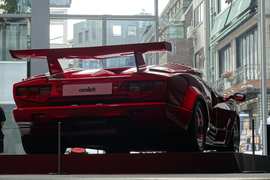
Hunaudières Concept: The 1999 Hunaudières concept car makes an appearance in the ‘garage’ scene.
Le Mans Winner: The Speed 8 that won Le Mans in 2003 is also present in the garage.
Pre-Production Model: The new Continental GT S is included, presented before its official embargo lift.
Project Codename: The codename for the Supersports project, ‘Mildred’, is printed on the hydraulic handbrake.
Bentley BEV: The new Bentley BEV appears twice—once in camouflage in the car park, and again under a silk cover after Travis smashes the door.
R-Type Continental: Bentley’s own 1953 R-Type Continental—the origin of the Continental GT design language—is displayed in a glass box where Travis turns left after the fly-by of the pre-war Bentleys.
EXP 15: The 2025 EXP 15 design vision car is located on the roof above the long straight.
Founding Year: The 199 race number on the Supersports’ front grille contains a black “1” between the two ‘9’ digits, creating 1919—the year Bentley was founded.
Continuity Lineup: The three cars Travis stops in front of at the end of the film include an original 1926 Supersports, flanked by the two most recent generations.
Paint Shop Palette: The line-up of colourful cars in the closing aerial shot mirrors the paint shades of the panels on the side of the Paint Shop.
Executive Action: The person cleaning up after Travis during the credits is Bentley’s Chairman and CEO, Frank-Steffen Walliser.
– ENDS –